




Green Technology: The Mobility of Tomorrow
Leave a CommentWhile the COVID pandemic has posed significant challenges worldwide, it also created an opportunity for us to slow down and reflect on vulnerabilities and inefficiencies in many areas of our social and economic structures. One of the concerns is our efforts towards sustainability, especially in regard to transportation. Dramatic reduction in transportation traffic during the COVID shutdowns revealed what kind of positive impact we could make if we curb the CO2 emission, especially in large cities.
Currently, as the largest producer of CO₂ emissions, transportation accounts for 24% of the total amount, with 74.5% coming from road vehicles. It is becoming increasingly evident that effective strategy to combat global warming requires a focused effort in city and transportation planning. Developing and deploying the transportation modes that are not dependent on fossil fuel is a key piece of this puzzle.

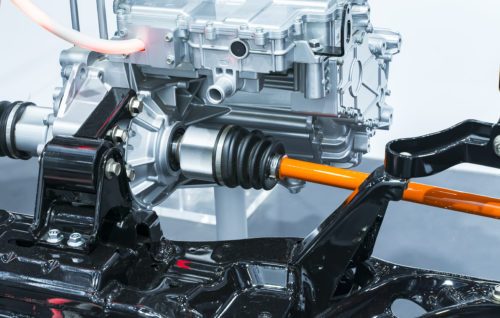
Most of the electric modes of transportation in the future will contain an electric drive system, at the heart of which is a rotating rotor that requires balancing to assure the lowest possible vibration and thus offer the smoothest operation of the vessel in motion at optimized sound levels.
Continuing urban growth is a major contributor to sustainable transportation. Reducing traffic congestion, decreasing the need for private vehicles, and increasing available urban space are some of the key factors in our societal and environmental success. Thanks to the innovators and industry leaders who are hard at work in driving the digital revolution and green technology, which are the vital components in transforming our cities to be more efficient and sustainable.
What Are Some Key Trends in Urban Mobility?
As we face the continuing growth of our cities, we must reimagine the future of urban mobility with the climate and social impact of our decisions in mind… Here are some key trends in urban e-mobility:
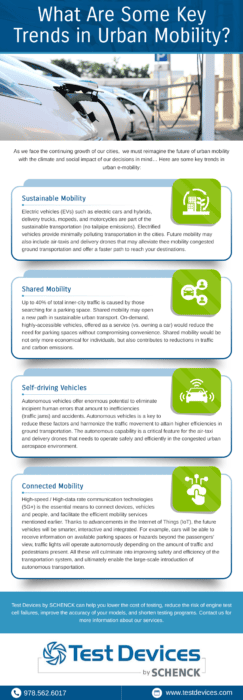
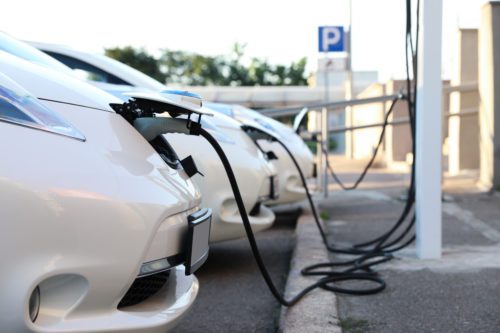
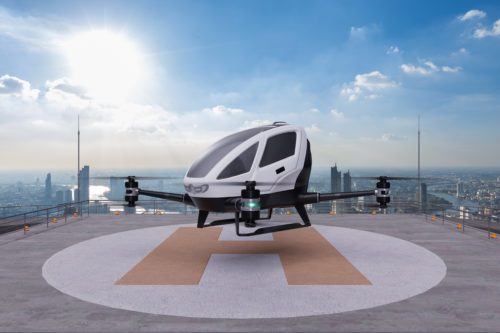
- Sustainable mobility: Electric vehicles (EVs) such as electric cars and hybrids, delivery trucks, mopeds, and motorcycles are part of the sustainable transportation (no tailpipe emissions). Electrified vehicles provide minimally polluting transportation in the cities. Future mobility may also include air-taxis and delivery drones that may alleviate the congested ground transportation and offer a faster path to reach your destinations.
- Shared mobility: Up to 40% of total inner-city traffic is caused by those searching for a parking space. Shared mobility may open a new path in sustainable urban transport. On-demand, highly-accessible vehicles, offered as a service (vs. owning a car) would reduce the need for parking spaces without compromising convenience. Shared mobility would be not only more economical for individuals, but also contributes to reductions in traffic and carbon emissions.
- Self-driving vehicles: Autonomous vehicles offer enormous potential to eliminate incipient human errors that amount to inefficiencies (traffic jams) and accidents. Autonomous vehicles is a key to reduce these factors and harmonize the traffic movement to attain higher efficiencies in ground transportation. The autonomous capability is a critical feature for the air-taxi and delivery drones that needs to operate safely and efficiently in the congested urban aerospace environment.
- Connected mobility: High-speed / High-data rate communication technologies (5G+) is the essential means to connect devices, vehicles and people, and facilitate the efficient mobility services mentioned earlier. Thanks to advancements in the Internet of Things (IoT), the future vehicles will be smarter, interactive and integrated. For example, cars will be able to receive information on available parking spaces or hazards beyond the passengers’ view, traffic lights will operate autonomously depending on the amount of traffic and pedestrians present. All these will culminate into improving safety and efficiency of the transportation system, and ultimately enable the large-scale introduction of autonomous transportation.
How Can Test Devices Serve “Green Technology” Trends?
Efficient and well-crafted rotating parts are the heart of many high-performance machines. This remains true for future e-mobility machines: Emerging classes of high-performance electric motors and compact power generator rotors are some of the examples. To support the continued development of sustainable technologies, Test Devices offers industry leading balancing equipment as well as the expert engineering services to meet your needs:
- Engineering Services
- We have 10 spin test facilities in two Centers of Excellence (COE) in the US and Europe, operated by experienced teams of testing experts.
- Spin testing: Proof / Overspeed test, LCF tests, burst tests, heated or cryogenic conditions – with various types of sensors and instrumentation for test
 data measurement.
- Rotor balancing: Including consulting for balancing strategy, strategy and process development for optimum production balancing for high volume production, and outsourced balancing services.
- Outsourced Production Services: Overspeed/proof spin tests, seasoning motor rotor, and CNC machining work.
- Production Equipment
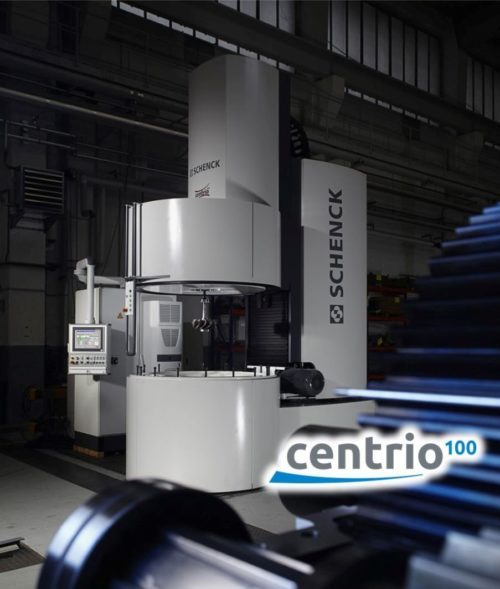
- Schenck is the industry leading provider of precision balancing machines and blade moment weighing scales. We provide the equipment with the highest industry standard to support your production needs to scale and achieve efficiencies.
- We offer engineering consultation on balancing strategy and process – An often underappreciated area of production that could cause a headache if ill prepared.
- Excellent after sales care: Unexpected downtimes are costly events, and must be avoided in a production. We have an experienced and well staffed team of technicians and engineers who will respond to your service needs who can address your needs in calibration and certification of balance machines, scheduled maintenance and repair work, as well as emergency troubleshooting.
 data measurement.
Choosing an Industry Leader in Test Devices
At Test Devices, our reputation for quality and innovation is proven and unparalleled. We offer industry-leading expertise and equipment to solve engineering problems for eliminating rotor unbalances and vibration problems for both new products in development and for manufacturing at a large scale.
We serve clients in the aerospace, aviation, automotive, energy storage, power generation, air handling, electronics, and medical devices industries, offering our customers the world’s most advanced and accurate spin testing, rotor balancing, and blade moment weighing equipment and services.
Testing Equipment and Services from Test Devices by SCHENCK
There is no doubt that the mobility of the future will be cleaner, more diverse, smarter and efficient. Green technology is a key initiative in achieving sustainable future transportation and vibrant cities.
If your company is developing mobility solutions, Test Devices by SCHENCK can help you lower the cost of testing, reduce the risk of engine test cell failures, improve the accuracy of your models, and shorten testing programs. Contact us for more information about our services.

 SCHENCK has a deep customer base in both the automotive and aerospace sectors. We offer innovative testing and production support services with the highest standard of process integrity and quality. SCHENCK is very familiar with and equipped to meet the rigorous pace of mass-production work required in the automotive industry.
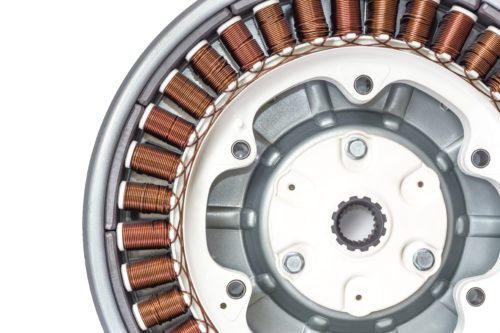 Fatigue test data enables electric motor manufacturers to understand the durability limit of the motor rotors, develop a dependable product life model to define appropriate product servicing life as well as establish a maintenance service schedule – the goal is to prevent any unexpected failure in the service life of the machine. Additionally, the data allows engineers to proactively plan for design improvements and modifications.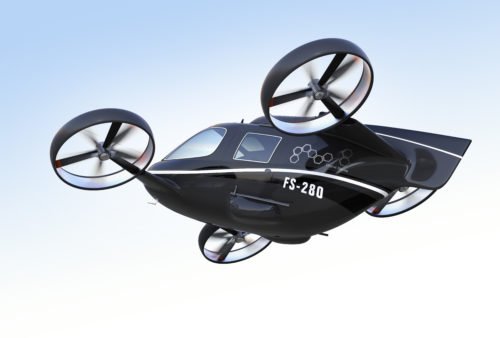
 To combat the global warming, electrifying the cars and airplanes are not enough. We must think of a way to make the whole energy supply chain green. Starting from how we generate fuel (or energy), transport and distribute it, and eventually how the byproduct of the fuel impacts the environment – the new greener supply chain must be a sustainable close-looped cycle.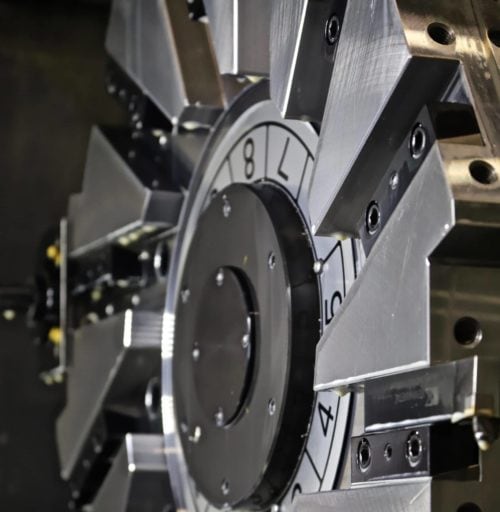
 At Test Devices by SCHENCK, our skilled and experienced staff brings extensive expertise to the manufacture of safety-critical rotating components made from challenging aerospace alloys. With a great deal of experience creating or adhering to the frozen manufacturing processes used by original equipment manufacturers (OEMs) in the aerospace sector, allowing us to guarantee a high rate of repeatability across each production run.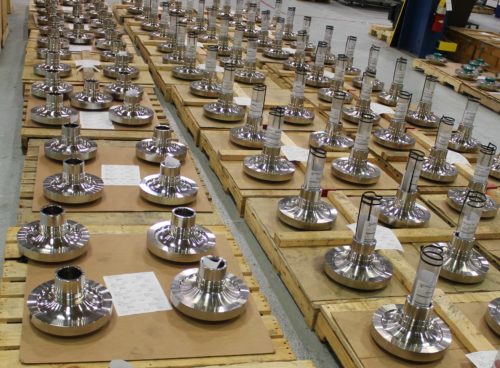
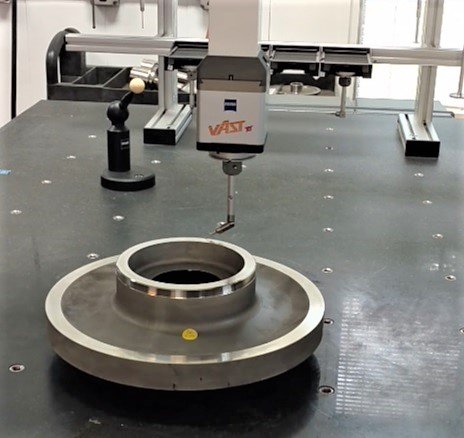 We are committed to providing
 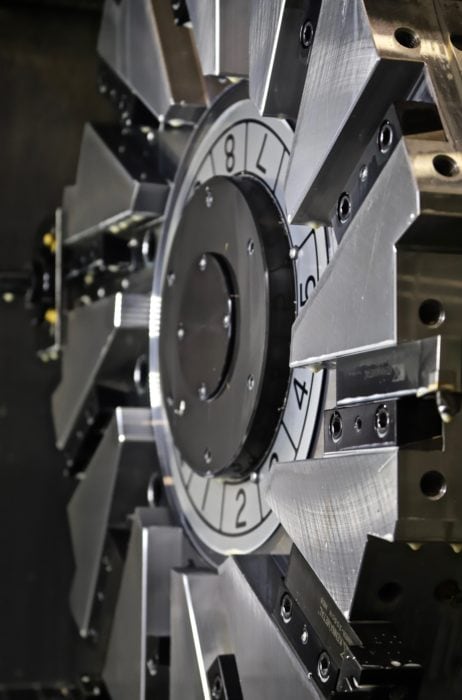 Rough and semi-finish machining for the aerospace sector requires precision equipment and experienced, knowledgeable engineers and operators that can navigate difficult or unexpected challenges during machining operations.