
Burst Testing & Safety Containment in a Spin Tester

 Home Page

 • Profile

 • One Stop Shopping

 Spin Test Services

 • Balancing Services

 • Burst Testing

 • Proof Testing

 • Strain Survey

 • Low Cycle Fatigue

 • Radial Growth Test

 • Tooling & Arbors

 • Crack Detection

 • High Cycle Fatigue

 • High Speed Video

 • Data Acquisition

 • Reporting

 Spin Test Equipment

 • Dynamic Spin Rigs

 • Turnkey Systems

 • Proof Test Equip

 • Air Turbines

 • Control Systems

 • Data Logging

 • LabVIEW Apps

 • Spare Parts

 White Papers

 Quality Systems

 Links

Burst Testing & Failure Analysis

Introduction

High speed rotating machinery store huge amounts of kinetic energy which is released upon burst of one or more of its components. The liberated projectiles can penetrate a machine housing and pose a significant, if not mortal, threat to personnel. Designers must take such events into account during FEMA (failure modes and effects analysis) reviews and provide containment capability in the form of metal or composite enclosures. Since burst events are rare but catastrophic events, containment tests should be conducted to validate its integrity.

As an example, a rotor weighing 272 kg (600 lbs) and having a diameter of 76 cm (30 in) and spinning at 14,000 rpm has an energy equivalent of 2.1 x 10⁷ Joules. To put that number in perspective, it is equivalent to a 80,000 lb tractor trailer traveling at 75 mph. Imagine the damage should that truck run into a barrier in its path. A large SUV traveling at 80 mph would only represent 10% of this energy. This kind of rotational energy is comparative to the power of some bombs. Within this context it is easy to see why a burst of a high speed rotating part is not something that a manufacturer would want to have happen in service. Even small rotors spinning at high speed can be extremely damaging during a burst.

Any product that does not protect the public in such cases, not only exposes the manufacturer to litigation and expensive insurance premiums, but will eventually force the OEM out of business or subject to rigorous regulation. To a lesser extent, the same is true for protecting collateral damage to equipment. In the energy generation business, collateral damage could amount to millions of dollars.

In order to prevent a burst that could maim or kill in addition to completely destroying surrounding equipment, manufacturers have two choices: make sure that the rotor is spinning well within the operating limits or provide a robust containment system. Preferably, some combination to the two.

Over-speed centrifugal stress testing to the point of burst offers valuable information on the ultimate strength of a part or material. However, the energy of high-speed parts poses a unique challenge regarding safety and containment. Companies are generally aware that performing these tests in-house can lead to disastrous results if the appropriate equipment is not used. Test Devices is expert in this field and has invested in the equipment and personnel that, together, provides the highest levels of safeguards for damage and personal injury. We have very rugged spin tests system (see equipment) which perform burst testing at designed energy levels above and below the rotor described above for both in-plane and out-of-plane projectiles. As an independent laboratory, our testing provides our customers, and the end users of their products, information regarding the safety of the products. An example of some applications include:

Applications

• Automotive flywheels • Turbofans • High speed machine tools
• Composite flywheels • Jet engine components • Grinding wheels
• Centrifuge rotors • Impellers • Electric motor rotors
• High speed fans • Compressor rotors • Gears
• Turbochargers • HVAC Fans • Turbine rotors


Reasons for Testing


  • Materials selection (technical)
  • Materials optimization (cost vs. performance)
  • Materials research (properties development)
  • Safety concerns (protection of the public)
  • Safety concerns (operator protection)
  • Containment & shield assessments (equipment protection)
  • Operating parameters
  • Liability assessments
  • Warranty assessments
  • Failure analysis
  • Design verification
  • CAE model verification (CAE = Computer Aided Engineering)

What Are the Advantages of Burst Testing?

1. Empirical evidence that the design parameters were reasonable and that all considerations have been investigated. If the speed at which the rotor bursts is within the predicted failure speed, the data will be used as validation of the design intent and subsequent engineering.

2. Reduction of manufacturing costs. By evaluating the failure modes and having good data, equipment designers can optimize the design of both the rotating and static equipment (containment).

3. Choosing materials for rotating components is dependent on requirements and material properties. Although slight changes in materials would seem harmless, until testing is done there is no way to know what the ultimate impact of the material substitute will be. Burst testing will validate the best choice of materials to meet all of the safety considerations at the most economical cost.

4. Plastic Strain Tests are burst tests where one spins a part up to the point of failure and measures the part’s ductility and whether it will remain in balance through its operating range.

Types of Tests

Simple burst Test – Run up to speed until burst. Data includes:
    Speed at burst
    Type of burst
        Rim Peel (
explanation)
        Tri- Hub (explanation)
    Return of burst fragments (bag of recovered test specimen parts – never 100%)

Reconstructed Fragments

Figure 1
Post-test disc fragments reassembled for review.

Heated Burst – Same as simple burst but with test specimen maintained at a specific temperature. Capability from ambient to 1150 °F (special applications to 1600 °F)
More closely represents real operating conditions. Data includes:
    Speed at burst
    Type of burst
    Temperature profile
    Return of burst fragments

Cooled / Cryogenic Burst – Same as simple burst but with test specimen maintained at a specific temperature below ambient. Capability from ambient to –320 °F.
More closely represents real operating conditions. Data includes:
    Speed at burst
    Type of burst
    Temperature profile
    Return of burst fragments

Plastic Strain Burst – Sensors mounted onto the test specimen to monitor the stain resulting from the high-speed stresses. This can be done in combination with any simple, heated or cooled test. The number of sensors is limited only by the size of the part and slip ring capability.
This test is most often used to validate CAE analysis. Data includes:
    Speed at burst
    Type of burst
    Temperature profile
    Stress/Strain plots for each sensor
    Return of burst fragments

Radial Growth & Burst – a profile of the changes in dimensions of a test specimen as it speeds up.
See Radial Growth (link to RG page) page for more details. Data includes:
    Speed at burst
    Type of burst
    Temperature profile
    Growth vs speed; plastic/elastic plots.
    Return of burst fragments

High Speed Video – used with any of the above tests and has the capability of recording the actual burst event. Aids in the failure analysis of the crack initiation site. When a burst occurs, a trip wire hit by an escaping disk fragment triggers the video camera that stores pre and post trip images. High-speed video (up to 40,000 frames per second) is used to capture the burst and containment event. This allows analysts to understand the size and kinematics of the projectiles and to optimize the design for minimum weight. Please see the High Speed video page.
The video results track the event and provide insight into the containment dynamics.

High Speed Video - Normal High Speed Video - with Crack High Speed Video - Bursting

Test article
during normal spin.

Initial crack formation.

Figure 2

Test article bursting.

Seeded Burst Test – this is a test that explores the capability of the customer designed containment to contain a burst of a rotor at actual operating speed. Normally, a safety factor is built into any rotor so it will not burst at operating speeds, requiring testing to an overspeed to cause a burst. With this in mind, why build a containment vessel to contain the energy from a burst scenario (at overspeed) which will never happen. By over designing, the manufacturer wastes money and may create a whole different set of problems. Therefore, running a test at a speed that represents actual operating conditions is sometimes more practical. To achieve this, we seed (insert) a defect into the test specimen and then run the part at operating speeds until it bursts. This will result in a more realistic test of the containment system.

The Test

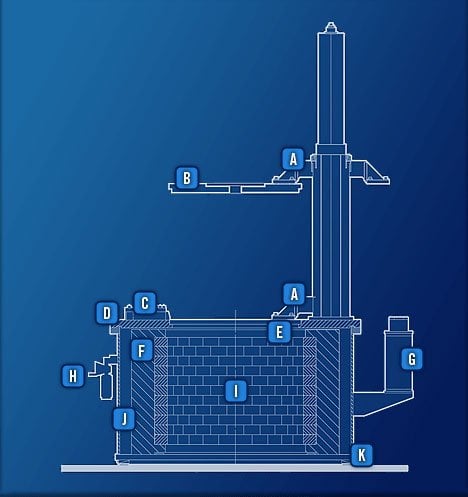
A typical burst-containment test involves a spinning disk, a properly supported containment structure, high-speed video, witness rings (explain what these are) and other instrumentation needed to quantify the event.

Test Schematic

Figure 3
An example of an auxiliary containment structure.
Note: The containment rings are mounted independent of the test article.

Test Devices can establish a test plan to replicate your operating conditions and give you data on your test specimen. A typical test consists of the following steps:

  • Analysis of the part and its ability to spin on an axis.
  • Design of the spin arbor and drive spindle.
  • Selection of the proper drive turbine.
  • Assembly of the test piece with the spin arbor.
  • Balance of test assembly (See Balance Page).
  • Mount proper turbine
  • Test turbine and spin system with dummy load.
  • Calibration of test set up
  • Start test
  • Spin test parts to failure (recording burst event with high speed video is the norm)
  • Collect data
  • Stop test
  • Recover burst fragments
  • Review data
  • Collect burst fragments and package to protect surfaces
  • Send burst fragments and test documentation to customer

Definitions

What are Burst Fragments? – Burst fragments are pieces of the original test specimen that remain after the test has been performed. Test Devices can also supply special proprietary capture systems to preserve the rotor fracture surfaces during burst, however, some of the smaller parts will become embedded in other materials inside the pit simultaneously so 100% recovery is rare. Nevertheless, we will recover the vast majority of the original test part pieces. We will remove these pieces from the spin pit chamber, package and return them for failure analysis review (return).

Spin Tester after Burst

Figure 4
Post-test disc fragments in Spin Pit.

What is Burst Debris? – Burst debris is a more generic term and includes not only burst fragments, but also other material such as pieces of probes, sensors, ovens, etc. destroyed during the burst and which accumulates at the bottom of the containtment vessel (spin test chamber).

What is a Containment Vessel? – An apparatus that will prevent the shrapnel from leaving the immediate area of the burst and protects both people and equipment nearby that would be subject to damage. There are numerous technologies to accomplish this and which can be tested in addition to the rotating part in our test chambers. Currently, there are no computer programs that accurately model potential failures in containment. (return)

What is a Rim Peel? – Rather than the entire test specimen disintegrating, a portion of the outer diameter comes off while the hub section remains intact. Less energy is dissipated, as a result, and therefore less dangerous (as in: it is less dangerous to stand in front of a SUV at 80mph than a locomotive at 80mph). If this were the failure mode, less containment would be required.(return)

What is a Tri-Hub Burst? – This is when the entire test specimen disintegrates and releases all of its energy. Typically, a part will decompose into 3 major pieces which carry about 1/3 of the energy in the part which containment vessels are designed to contain. While more numerous pieces are possible, they are easier to contain, especially for penetration of the containment vessel (return).

What is Documentation? - Includes all information agreed upon for the test plan and could include plots, certifications, videos, TIF files, photographs, etc. Test Devices, Inc. provides a formal certification document for each article or lot as required. All test documentation and report material is archived for 7 years at Test Devices, Inc. and is available for inspection or duplication.

What is Burst Contingency & Repair – As discussed earlier, rotating parts store large amounts of energy and, by definition, all that energy will be released during a burst. While our test systems are very robust, there will be some minor damage by the very nature of the test. Damage to the turbine or other equipment due to burst testing is assessed on a time and materials basis up to the limit of the burst contingency. The burst contingency should be accounted for in the testing budget and indicated on the purchase order.

For additional information of answers to specific questions, please contact us.


Copyright© 2003, 2004, 2005, 2006, 2007 Test Devices Inc  |  571 Main Street  |  Hudson, MA 01749-3035 U.S.A.
PHONE: 978.562.6017  |  FAX: 978.562.7939  |  EMAIL: sales@testdevices.com